 Thompson.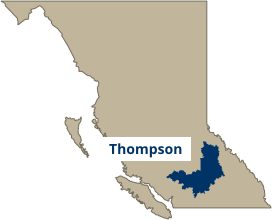
Know before you go
Advisories
Visitor guidelines

Get park information
Look in this ‘visitor guidelines’ section for general safety instructions and other important information about this park. For the latest information, see advisories.

Horseback riding not recommended
Although horseback riding is allowed in Pukeashun Park, we do not recommend it, for safety reasons. This is a remote area with rugged terrain. There is a significant risk of conflict with bears and other wildlife.

Drive safely on access roads
Use extra caution when driving on access roads. Watch for wildlife crossing the road. For more information on staying safe in remote areas, see our backcountry guide.

Stick to the established trail
There are no designated hiking trails in Pukeashun Park. There is one user-established trail leading to Grizzly Lake. For your own safety and to protect the local environment, hike only on the established trail.
For additional information on hiking in Pukeashun Park, see the hiking section. To get more guidance on safe, environmentally friendly hiking, please watch our short video guide to responsible day-hiking.

Leave No Trace
Always follow Leave No Trace outdoor ethics. Minimize impacts on plant and animal life and be considerate of other visitors. Dispose of waste properly.
For detailed information on outdoor ethics, visit the Leave No Trace Canada website.

Stay safe around wildlife
Potentially dangerous animals live in this park, including grizzly bears, black bears, and wolves. On trails, make noise, to prevent unexpected encounters. Be aware that food waste and other scents will attract wildlife.
To learn how to avoid encounters and ensure unavoidable encounters do not escalate, see the wildlife safety page.

Prepare for winter conditions
During winter, you may run into dangerous conditions at this park. Ensure you are properly equipped before visiting. For more information, on staying safe when visiting BC Parks in winter, see the winter safety page.

No drones
Operating drones without permission is illegal in BC Parks. In the rare cases when we grant permission, you must keep your drone away from wildlife and other visitors.

No harvesting
Harvesting mushrooms or any other crops is forbidden in all BC Parks. The only exceptions are for Indigenous Peoples and research permit holders.
Review the detailed guides under visit responsibly for more information on staying safe and preserving our natural spaces.
Visit responsibly
Follow these guides to ensure your activities are safe, respectful, and ecologically friendly:
Maps and location
Getting there
Pukeashun Park is 30 km from Scotch Creek and 93 km from Kamloops. You can access the park by traveling approximately 40 km up Road 670 off the Squilax/Anglemont highway. You may find it impossible to access the park during the winter. For the latest information on conditions, see the advisories.
Things to do
Backcountry hiking is allowed in Pukeashun Park. There are no designated hiking trails in the park. There is one user-established trail leading to Grizzly Lake. BC Parks does not maintain this trail.
The trail is often somewhat wet. Hiking conditions are usually better in late summer and early fall, once the trail has had time to dry out. For your own safety and to protect the local environment, stay on the established trail.

There are fishing opportunities in Pukeashun Park. Grizzly Lake provides a modest native rainbow trout fishery.
For anglers hoping to visit Grizzly Lake, we recommend bringing a carry-in vessel, such as an inflatable raft or kayak.
Please consider using catch-and-release methods and barbless hooks, so that other visitors can enjoy the fishery.
Anyone fishing in British Columbia must have an appropriate licence. To learn more, see the fishing and hunting guide.

Wildlife viewing opportunities are available in Pukeashun Park, but BC Parks does not provide any viewing platforms. This park is home to grizzly bears, black bears, mountain caribou, moose, mountain goats, and wolves. Grizzly bears travel throughout the park and congregate around bodies of water.
Be extra cautious when fishing, hiking, and camping. On trails, make noise, to prevent unexpected encounters. Be aware that food waste and other scents will attract bears and other potentially dangerous wildlife. To learn more, see the bears section of the wildlife safety page.
Dogs and other pets are allowed in Pukeashun Park, but they must be leashed and under control. There is high potential for conflict between unleashed pets and bears or other wild animals in this park. However, in some cases, having a well-controlled dog with you may help to prevent a wildlife encounter.
For more information on bringing pets to BC Parks safely and responsibly, see the pet etiquette section of the responsible recreation page.

Hunting is allowed in Pukeashun Park. Anyone hunting in British Columbia must have an appropriate licence. Check the provincial hunting and trapping regulations synopsis for seasons and closures.
Anyone hunting in British Columbia must comply with BC hunting regulations. To learn more, see the fishing and hunting guide.

Pukeashun Park offers winter recreation opportunities including cross-country skiing, snowshoeing, and snowmobiling. BC Parks does not maintain any trails for these activities. For information, on staying safe when visiting BC Parks in winter, see the winter safety page.
About this park
Pukeashun Park was established to protect this area’s unique landscape and wildlife. The terrain includes a high-elevation pass, a lake with forested slopes, subalpine parkland, and alpine tundra. There are large wetlands in the Grizzly Lake valley with exceptionally large old-growth spruce and subalpine fir.
Pukeashun Park includes habitat for mountain goats, grizzly bears, black bears mountain caribou, Moose, and wolves. A range of other alpine habitat species also live here. The waters contain native stocks of rainbow trout.
Reconciliation with Indigenous Peoples
BC Parks honours Indigenous Peoples’ connection to the land and respects the importance of their diverse teachings, traditions, and practices within these territories. This park webpage may not adequately represent the full history of this park and the connection of Indigenous Peoples to this land. We are working in partnership with Indigenous Peoples to update our websites so that they better reflect the history and cultures of these special places.
Contact
| General questions and feedback for BC Parks | We answer emails weekdays from 9 am to 5 pm Pacific Time. |
|---|