 Omineca.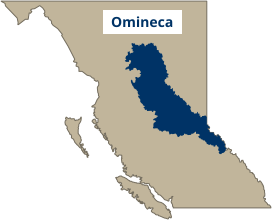
Know before you go
Advisories
Visitor guidelines

Get park information
Look in this ‘visitor guidelines’ section for general safety instructions and other important information about this park. For the latest information, see advisories.

Check the Berg Lake Trail conditions
BC Parks is excited to welcome you back to the Berg Lake Trail, after extensive repairs to the entire trail. Please check the advisories for updates before heading to the park.

Stay safe
Many of Mount Robson Park’s trails, walks, and backcountry areas present significant hazards. Slippery rocks, cliffs, uneven trail surfaces, wildlife, fast-flowing rivers, and waterfalls can all be dangerous, even to experienced visitors.
For the safest possible trip:
- Ensure your children are under constant supervision, as there are potential hazards throughout the park
- Carry a first-aid kit and make sure someone in your party knows how to manage basic first-aid emergencies
The nearest hospitals are in McBride to the west and Jasper to the east, both on Highway 16. There is also a medical clinic in Valemount, 35 km southwest of the park, on Highway 5.
Look in this ‘visitor guidelines’ section for more safety instructions and other important warnings about this park. For the latest information, see advisories.
Boil water before use on the Berg Lake Trail
The Berg Lake Trail has a permanent boil-water advisory. Boil, filter, or otherwise treat any water gathered on the trail before drinking it or using it for anything else. For more information, see HealthLink BC’s advice on purifying your drinking water.
Water from taps in many frontcountry areas in this park is safe to use without treatment. Water from the hand pumps in the Lucerne area should be treated before use. For more information, see drinking water.

Prepare for winter conditions
During or following certain weather patterns, you may run into dangerous conditions at Mount Robson Park, especially in winter. Check the advisories for trail conditions and ensure you are properly equipped before visiting this park.
Weather forecasts for this area are available from:
No off-road vehicles
Cars, motorcycles, and other motor vehicles can only be used on park roads and in parking areas. ATVs, snowmobiles, and other off-road vehicles are not allowed in Mount Robson Park. This includes vehicles registered under the Off-Road Vehicles Act.
No harvesting
It is illegal and potentially dangerous to eat mushrooms, berries, or anything else that grows in Mount Robson Park. Harvesting any crops is forbidden in all BC Parks. The only exceptions are for Indigenous Peoples and research permit holders.

Limited cell phone service
The Welcome Centre is the only place in Mount Robson Park with any cell phone service. The Welcome Centre also has public payphones and wireless internet.
There is no cell phone service anywhere else in this park. If you are hiking in the backcountry, bring paper maps for navigation. Consider bringing a satellite phone for emergencies.
Review the detailed guides under visit responsibly for more information on staying safe and preserving our natural spaces.
Visit responsibly
Follow these guides to ensure your activities are safe, respectful, and ecologically friendly:
Reservation policies
Get information on:
Maps and location
An updated Berg Lake Trail map will be published soon.
- Park map [PDF]
- Berg Lake Trail map [PDF]
- Lucerne area map [PDF]
- Mount Fitzwilliam Trail map [PDF]
- Mount Fitzwilliam Trail brochure [PDF]
- Robson Meadows Campground map [PDF]
- Robson River Campground map [PDF]
Bathymetric maps:
Getting there
Mount Robson Park is in east-central British Columbia, just west of the Alberta border and Jasper National Park. The park is approximately:
- Four hours north of Kamloops on Highway 5
- Three-and-a-half hours east of Prince George on Highway 16
- Five hours west of Edmonton on Highway 16
The closest communities are Jasper, Valemount, and McBride. There are commercial airports in Prince George, Kamloops, and Edmonton. Rental vehicles are available at the airports.
Things to do
Berg Lake Trail
The Berg Lake Trail is a world-renowned backcountry hiking route featuring some of the finest scenery in British Columbia. Long-term trail closures have been common in recent years. Always check our advisories for the latest conditions and closures before planning your trip or heading to the park.
For detailed information about hiking the Berg Lake Trail, see the Mount Robson Park: Berg Lake Trail page.
East end wilderness trails
There are several trails at the park’s east end. These range from well-developed, hard-surface trails like Yellowhead Mountain Trail to remote backcountry routes like Moose River Trail. To learn more, see the east end wilderness trails page.
Corridor
Waterfalls and salmon-viewing walks can be found along the Mount Robson Corridor. Behind the Welcome Centre, there is the 1 km self-guided Journey Through Time interpretive trail, which is very popular.
Robson Meadows and Robson River
Walks and hikes are available from the campgrounds. To download maps showing the trail routes, see maps and location.
Lucerne
The self-guided Labrador Tea Trail runs through interesting mixed forest next to the campground.
Lucerne
A swimming beach is available on Yellowhead Lake, near Lucerne Campground. The water stays cold year-round.
There are no lifeguards on duty in BC Parks.
To prevent the transmission of whirling disease, the use of all motorized and non-motorized watercraft, as well as wading gear (including wading bibs, pants and boots) are prohibited within Mount Robson Park. Fishing is still permitted within the park along the shorelines, with the use of a clean rod and lure.
Corridor
Portal Lake has a good stock of rainbow trout. Yellowhead and Moose lakes offer bull trout, lake trout, rainbow trout, kokanee, and whitefish.
Robson Meadows and Robson River
There are seasonal fishing opportunities in the Fraser River throughout the Robson Meadows and Robson River areas of the park.
Anyone fishing in British Columbia must have an appropriate licence. To learn more, see the fishing and hunting guide.

Your family can enjoy fun summer outdoor learning experiences with Discover Parks Ambassadors at Mount Robson Park all summer long. For detailed information on these and many more seasonal and year-round activities in BC Parks, visit discoverparks.ca.
Other interpretive programs and presentations are sometimes available at Robson Meadows Campground. For more details, speak with the park operator when you arrive at the park. You can also check the information board in the Welcome Centre’s entrance hall.
Excellent opportunities for wildlife viewing are available in Mount Robson Park. From the highway corridor, you may see mule deer, whitetail deer, moose, elk, wolf, coyote, black bear, and various waterfowl.
Also from the highway corridor, you may safely view mountain goats and grizzly bears on mountain slopes and cliffs. If you spot any animals while driving through this area, take extra care to keep driving safely.
When viewing wildlife, keep clear and give them the space they need to ensure their safety and yours. Bring binoculars, so you can view wildlife from a safe and respectful distance.
In the spring, cow elk, moose, and deer become extremely protective of their young. Elk have particularly short tempers when confronted with anything they perceive as a threat to their young.
In the fall, the males of these species can become aggressive. The mating or rutting season in September and October can make even the most seemingly docile elk, moose, or deer aggressive.
For more information on animals that you may spot in this park, see the wildlife section. For more on safe, responsible viewing, see the wildlife safety page and the wildlife section of the responsible recreation page.
Dogs and other pets are welcome in many parts of Mount Robson Park, but they must be leashed. Pets are not allowed in designated beach areas or park buildings. You must be in control of your pets and dispose of their waste appropriately.
Berg Lake Trail
Leashed dogs are allowed on parts of the Berg Lake Trail, but only for day-hikes. Dogs are not allowed on the Snowbird Pass portion of the Berg Lake Trail, which heads southeast away from Robson Pass. For more information on the trail route, see the Mount Robson Park: Berg Lake Trail page.
Dogs are not allowed on overnight camping trips on any part of the trail. Please remember that, where dogs are allowed, they must be leashed.
In most of Mount Robson Park, cycling is allowed only on roads where motor vehicles are permitted. Cycling is not allowed on trails in this park, except for parts of the Berg Lake Trail.
Cycling is allowed on the first 7 km of the Berg Lake Trail, up to Kinney Lake. No bicycles are allowed past Kinney Lake. For more information, see the cycling section of the Mount Robson Park: Berg Lake Trail page.
Bicycle helmets are mandatory in British Columbia. No bicycle rentals are available in the park. To learn about e-biking in Mount Robson Park, see the e-biking section, below.
Corridor
Riding is allowed only on the Moose River Route, which is suited to only the most experienced backcountry travellers. Before heading out, check the advisories for any information on conditions.
Horseback riding is not allowed in any other parts of Mount Robson Park.
Mount Robson Peak
Climbers from around the world are drawn to Mount Robson Park to take on the challenge of Mount Robson Peak. Standing at 3,954 m (12,972 ft), it may not be Canada’s highest peak, but few mountains anywhere offer nearly 3,000 m (10,000 ft) of uninterrupted ascent.
Mount Robson is suitable only for highly experienced climbers. Unexpected changes in the weather are common, especially in snow conditions. Heavy snowfalls, avalanches, icefall, and rockfall are also common throughout the climbing season.
Only those who are fully equipped, well-prepared, and highly skilled in all aspects of mountaineering should attempt climbing Mount Robson. We encourage you to use the voluntary self-registration kiosk at the Berg Lake Trailhead. For more information, download the climbers’ information links [PDF].
There are spelunking and caving opportunities in Mount Robson Park. However, all these opportunities are dangerous and involve significant personal risk. Only highly experienced and physically fit cavers with appropriate equipment should attempt them.
White-Nose Syndrome
White-Nose Syndrome is a fungal disease linked to the mass die-off of hibernating bats in Eastern North America. Humans have accelerated spread by bringing contaminated clothing, gear, and equipment into caves.
To learn more about White-Nose Syndrome, read the White-Nose Syndrome fact sheet [PDF], or visit the Canadian Wildlife Health Cooperative website. Before you enter a cave, use the gear decontamination instructions [PDF].
Help protect bats and their habitats from the spread of White-Nose Syndrome. Clothing and gear that has been used in caves east of the Rocky Mountains should not be used in B.C.
There are opportunities for snowshoeing and backcountry skiing in Mount Robson Park, but no tracks are set. Snowshoeing and backcountry skiing trails follow the hiking trails.
Plan your trip appropriately for winter conditions and visit Avalanche Canada for backcountry information and avalanche training. To get maps, see the maps and location section.
For information on using the Berg Lake Trail in winter, see the Mount Robson Park: Berg Lake Trail page.
About this park
The Texqa'kallt Nation, the earliest known inhabitants of the upper Fraser area, named Mount Robson Yuh-hai-has-kun. The Secwépemc People traditionally call it Tsyécelcten in the Secwepemctsin language. Both loosely translate as ‘the mountain of the spiral road’, referring to the mountain’s layered appearance.
Indigenous Peoples played a major role in the early days of exploration and trade around Yellowhead Pass and Tete Jaune. Although they are not always given credit, Indigenous Peoples guided and provided food to those who may have otherwise floundered.
Mount Robson Park is the second-oldest BC Park. It was established in 1913 to protect the Fraser River’s headwaters. With seven connected parks, it is part of one of the world’s largest protected areas. It was designated part of the Rocky Mountains World Heritage Site, in 1990 by UNESCO.
The area has long been used by Indigenous Peoples (see cultural heritage). In the early 1800s, settlers began to explore the area now known as Mount Robson Park.
The main feature of the Mount Robson Park, from a conservation perspective, is the Fraser River, specifically its headwaters. Over 100 km of the Fraser’s headwaters are protected by this park.
The headwaters start as a small creek in the park’s southeast corner near the Alberta border. The river ends over 1,200 km away, running into the Pacific Ocean off Vancouver.
Mount Robson Park’s flora and fauna epitomize the western slopes of the Rocky Mountains, North Continental Range. On some trails, you can travel between three different vegetation zones during a day-hike.
The park was established to protect a complex range of mountain ecosystems that change as the elevation increases. From cedar hemlock in the valley bottoms, up to spruce and fir growth, and finally an alpine tundra.
Among the landscape this park protects is Mount Robson itself, the largest peak in the Canadian Rockies at 3,954 m. The park also protects the Ramparts formation, alpine areas, rivers, lakes, and a highly valued wetland habitat.
The University of Victoria’s Mountain Legacy Project has included Mount Robson Park in its decades-long project to understand landscape change. This work was completed in part with funding provided by our Living Lab Program.
Read the Mountain Legacy Project report Mount Robson and Mount Assiniboine Parks: examining 100 years of landscape change.
As the landscape changes, so do the birds and animals who live in that landscape. BC Parks is committed to preserving the flora and fauna of this park by leaving vast swathes of the park without any trails or other facilities.
BC Parks works with neighbouring National Parks and forestry companies to maintain the park’s ecological diversity. We are committed to ensuring this area does not become an isolated biological ‘island’.
All wildlife indigenous to the Rocky Mountains can be found in Mount Robson Park. Wildlife populations are allowed to ebb and flow with minimal intervention from humans.
To date, 42 species of mammals, four amphibians, one reptile, and 182 species of birds have been recorded in the park. These species are typical of the moist, western slope of the Rocky Mountains.
There are excellent wildlife viewing opportunities in this park. Deer, moose, elk, and black bears can be seen at the lower elevations. Grizzly bears, caribou, mountain goats, and mountain sheep are spotted at higher elevations.
The Bird Blitz takes place in Mount Robson Park every June. Enthusiasts come to enjoy the spring scenery and the opportunity to observe this park’s incredible bird population.
In keeping with our mission to protect this park’s ecosystems, large areas are kept inaccessible to humans. This helps to make the level and diversity of animal species sustainable.
If you are in the park to view wildlife, please do so responsibly. Observe animals from a distance, preferably through binoculars. For detailed information, see the wildlife viewing section of the wildlife safety page.
In the spring, cow elk become extremely protective of their new calves. They can become aggressive when confronted with anything they perceive as a threat to their young. Moose and deer also actively defend their young.
In the fall, the males of these species can become aggressive. The mating season in September and October can make even the most seemingly docile elk, moose, or deer aggressive.
Reconciliation with Indigenous Peoples
BC Parks honours Indigenous Peoples’ connection to the land and respects the importance of their diverse teachings, traditions, and practices within these territories. This park webpage may not adequately represent the full history of this park and the connection of Indigenous Peoples to this land. We are working in partnership with Indigenous Peoples to update our websites so that they better reflect the history and cultures of these special places.
Contact
| Reservations, changes, and cancellations | Our call centre is open from 7 am to 7 pm Pacific Time. There is a $5 fee for reservations, changes, or cancellations made by phone.
|
|---|---|
| Welcome Centre | Mount Robson Welcome Centre provides information about the park and surrounding area. It also provides check-in for camping on the Berg Lake Trail. Please do not contact the Welcome Centre about your camping reservation. All reservations must be made through the BC Parks reservation service. |
| Frontcountry campgrounds and facilities | Frontcountry facilities are operated by Quartz Contracting. Please do not contact the park operator about camping reservations. All reservations must be made through the BC Parks reservation service. |
| General questions and feedback for BC Parks | We answer emails weekdays from 9 am to 5 pm Pacific Time. |