 Omineca.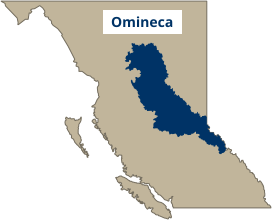
Know before you go
Advisories
Visitor guidelines

Gather essential information before your trip
Look in this ‘visitor guidelines’ section for general safety instructions and other important information about the Berg Lake Trail. For the latest information, see advisories.

Make a camping reservation
In peak season, you must book a reservation to stay at campgrounds on the trail. When reservations are available, we strongly recommend booking as early as possible.
For more information, see the Berg Lake Trail at Mount Robson Park section of the backcountry camping reservations page.

Check the trail conditions
BC Parks is excited to welcome visitors to the Berg Lake Trail, after extensive repairs to the entire trail. Check the advisories for information on trail conditions and closures before heading out to the park.

Stay safe
The Berg Lake Trail includes many potentially significant safety hazards. Slippery rocks, cliffs, uneven trail surfaces, wildlife, fast-flowing rivers, and waterfalls can all be dangerous, even to experienced visitors.
Closely follow all the safety advice outlined on this page. For the latest information, see advisories. Carry a first-aid kit and ensure someone in your party can manage first-aid emergencies.
The nearest hospitals are in McBride to the west and Jasper to the east, both on Highway 16. There is also a medical clinic in Valemount, 35 km southwest of the park, on Highway 5.

Stick to the designated trail
For your own safety and to protect the local environment, hike only on the designated trail. Hiking off-trail damages fragile ecosystems and causes erosion.

Leave a trip plan
Before heading out onto the Berg Lake Trail, even just for a day-hike, always make a detailed trip plan. Leave your trip plan with someone you trust, to help emergency services find your party, if you run into trouble.
You can make an ideal trip plan using the AdventureSmart trip plan tool.

Prepare for winter conditions
During or following certain weather, you may run into dangerous conditions on the Berg Lake Trail, especially in winter. Check the advisories for the latest updates and ensure you are properly equipped before using this trail.
Weather forecasts for this area are available from:
Camp on designated sites
Camping on the Berg Lake Trail is only allowed on tent pads or other established sites at designated campgrounds. Designated campgrounds should be visible all year round, even in the snow, due to tree clearance.

Leave No Trace
Always follow Leave No Trace outdoor ethics. Minimize your impact on plant and animal life and be considerate of other visitors. Dispose of waste properly.
For detailed information on outdoor ethics, visit the Leave No Trace Canada website.
No campfires
There is a permanent campfire ban on the Berg Lake Trail. Campfires are not allowed anywhere along the trail, at any time of year. Bring a portable stove for cooking.
Anyone found starting or maintaining an open fire may be ticketed or, in some cases, evicted from the park.

Take extra care when bringing animals
We do not recommend bringing animals into backcountry areas because of the potential for conflict with wildlife. For information on avoiding dangerous encounters, see wildlife safety.
Dogs are allowed on the Berg Lake Trail for day-hikes only. Overnight trips with dogs are not allowed. When bringing your dog on a day-hike, please remember:
- Keep your dog on-leash throughout your visit
- Pick up their waste and take it with you when you leave
- Dogs are not allowed on Snowbird Pass
For more information, see the pet etiquette section of the responsible recreation page. Horses are not allowed on the Berg Lake Trail.

Stay safe around wildlife
Potentially dangerous animals live in this park. On trails, make noise, to prevent unexpected encounters. Be aware that food waste and other scents will attract wildlife.
To learn how to avoid encounters and ensure unavoidable encounters do not escalate, see the wildlife safety page.

Always boil water before use
The Berg Lake Trail has a permanent boil-water advisory. Always boil, filter, or otherwise treat water before drinking it, cooking with it, or using it for anything else.
For more information, see HealthLink BC’s advice on purifying your drinking water.
No harvesting
Harvesting mushrooms or any other crop is forbidden in all BC Parks. The only exceptions are for Indigenous Peoples and research permit holders. Never eat mushrooms, berries, and other natural items, as this is illegal and can be hazardous.

No cell phone service
There is no cell phone service on the Berg Lake Trail. Bring paper maps and consider bringing a satellite phone for emergencies. Cell phone service, public payphones, and wireless internet are available at the Mount Robson Park Welcome Centre.
Review the detailed guides under visit responsibly for more information on staying safe and preserving our natural spaces.
Visit responsibly
Follow these guides to ensure your activities are safe, respectful, and ecologically friendly:
Maps and location
Getting there
The Berg Lake Trail begins at the end of Kinney Lake Road in Mount Robson Park. This trailhead is near the park’s entrance and Welcome Centre. The park is just west of the Alberta border and Jasper National Park. It is approximately:
- Four hours north of Kamloops on Highway 5
- Three-and-a-half hours east of Prince George on Highway 16
- Five hours west of Edmonton on Highway 16
The closest communities are Jasper, Valemount, and McBride. There are commercial airports in Prince George, Kamloops, and Edmonton. Rental vehicles are available at the airports.
Maps
An updated Berg Lake Trail map will be published soon.
Things to do
The Berg Lake Trail is a world-renowned backcountry hiking route. Long-term trail closures have been common in recent years. Always check our advisories for the latest conditions and closures before heading to the park. For a route map, see maps and location.
There is no permit or day-use fee for day-hiking on the Berg Lake Trail. However, for multi-day hiking and camping trips, you must book a reservation during the peak season. For information about camping along the trail, see the backcountry camping section.
The trail begins at the end of Kinney Lake Road near the Welcome Centre. It continues into the mountains to Robson Pass. There is a park operator station at Whitehorn and a ranger station at Robson Pass. Rangers may be available at Robson Pass, to assist hikers and campers.
The trail crosses the Alberta border through Robson Pass. Check the Jasper National Park webpage to learn about hiking beyond this point. Within the boundary of Mount Robson Park, Snowbird Pass heads southeast away from Robson Pass.
Dogs are not allowed on Snowbird Pass. This area is closed annually between May 1 and July 1 to allow for wildlife calving.
Mount Robson Marathon
Every year, on the second Saturday of September, runners from across the world participate in the Mount Robson Marathon. They can choose from 5 km, 12 km, and half-marathon categories. Additionally, an ultra-marathon spans the full length of the Berg Lake Trail.
For more information on this event, please visit the Mount Robson Marathon website.
Leashed dogs are allowed on the Berg Lake Trail for day-hikes only. Overnight trips with dogs are not allowed and dogs are not allowed on Snowbird Pass. You must be in control of your dog and take their waste with you when you leave.
Cycling is allowed on the first 7 km of the Berg Lake Trail, from the trailhead to the north end of Kinney Lake. A bike rack is available just past the Kinney Lake shelter for those wishing to explore the area further on foot. Bicycles must keep to park roads and designated trails. Bicycle helmets are mandatory in B.C.

The Berg Lake Trail is open for winter use. For details, see winter camping. Plan your trip appropriately for winter conditions and visit Avalanche Canada for backcountry information and avalanche training. To get maps, see the maps and location section.